June Mushroom of the Month:
Laetiporus cincinnatus // White-Pored Chicken of the Woods
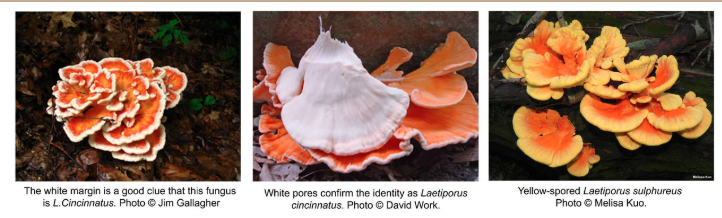
One of the most striking fungi of early summer, Laetiporus cincinnatus appears like a cluster of oversized peach-orange flower petals erupting from the forest floor. Unlike its close relative, the more common Laetiporus sulphureus, which typically grows directly from tree trunks and has yellow pores, L. cincinnatus usually fruits at the base of hardwood trees or from buried roots and features a white pore surface underneath. In Illinois, it is most commonly associated with oak and often appears after periods of warm summer rain.
Young specimens are thick, soft, and vividly colored, with pale margins that contrast against the deeper peach tones of the pore surface. As they mature, the shelves become tougher and more brittle, fading toward cream and washed-out orange hues. The species name “cincinnatus” is named for Cincinnati, Ohio, where American mycologist Andrew Price Morgan first collected and described the type specimen in 1885.
This fungus is a brown rot polypore, meaning it breaks down the cellulose in wood while leaving behind crumbly, lignin-rich remains. Despite its role in decomposition, it is perhaps best known among foragers as one of the classic “choice edibles” of North America, prized for a texture and flavor often compared to chicken when young and fresh – and cooked properly. As with many wild mushrooms, some individuals may experience sensitivities, and careful identification is essential.
Laetiporus is a great genus for beginners to learn, as it has no known deadly lookalikes in our region and is generally easy to recognize once encountered in the field.